Claude Code, Anthropic's agentic CLI built on the Claude model family, has quietly become the most useful tool in our engineering stack. It is not another autocomplete plugin. It runs in your terminal, reads your project, edits files, runs tests, and explains its reasoning along the way. After six months of using it in production across web, mobile, and POS projects, here is the honest field report.
What Claude Code actually is
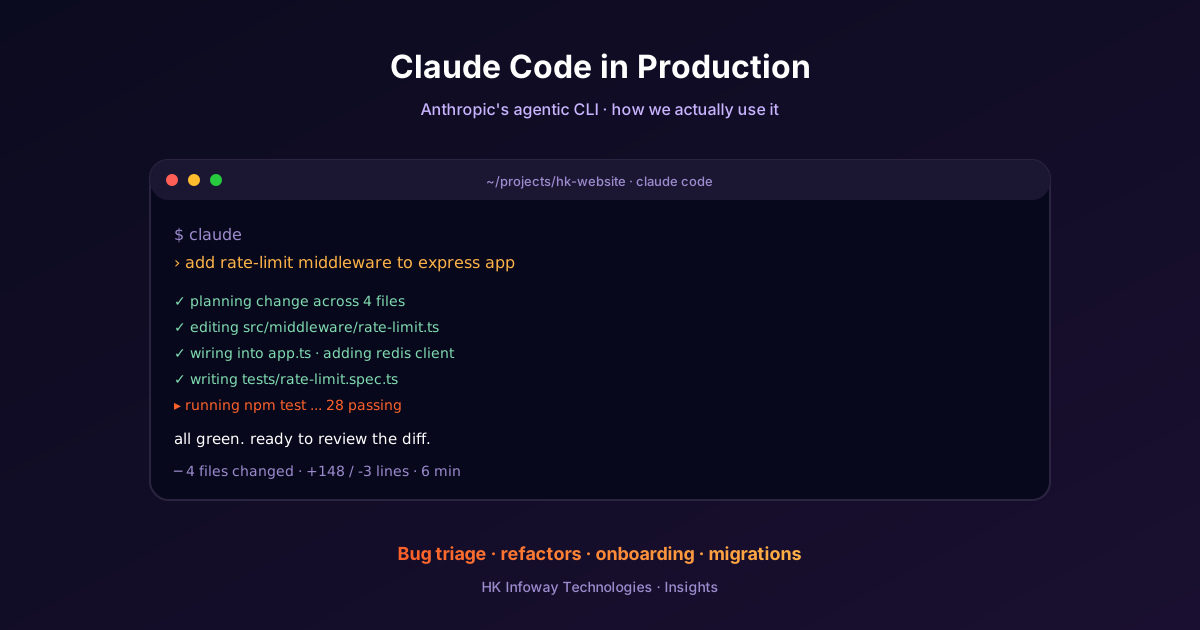
Think of it as a senior pair programmer who lives in your terminal. You type a goal in natural language, "add a rate-limit middleware to this Express app with Redis token-bucket logic, write tests, run them", and Claude Code plans the change, edits the right files, runs the tests, and reports back. It can use tools (Bash, file edits, web search), spawn parallel sub-agents, and operate on huge codebases thanks to its 1M-token context window in Opus mode.
The workflows that paid for themselves in week one
- Bug triage at speed. Paste a stack trace, point to the repo, and Claude Code locates the offending file, proposes a fix, writes a regression test, and runs the suite. What used to be a half-day spelunk is now a 12-minute task.
- Refactor with confidence. "Rename
getCwdtogetCurrentWorkingDirectoryeverywhere, update tests, run lint." 47 files across 9 packages. One command. Done. - Codebase onboarding. When a new engineer joins, we ask Claude Code to write a CLAUDE.md and walk them through architecture, conventions, and gotchas. It is faster than a senior doing it manually, and it stays up to date.
- Migration plumbing. Database migrations, framework version bumps (Next 13 → 14, SwiftUI iOS 16 → 17), test-runner swaps. The kind of grunt work that nobody wants to plan into a sprint.
The CLAUDE.md file: your repo's instruction manual
The single highest-leverage thing we did was write good CLAUDE.md files. This is a markdown file at your repo root that tells Claude Code the conventions, the architecture, the do-nots, and the "if you change X, also touch Y" knowledge that lives in senior engineers' heads. With a 200-line CLAUDE.md in place, Claude Code's output quality jumped from "useful draft" to "ready to merge" on most tasks.
Where it still falls short
- Tight visual UI work. Pixel-perfect design implementation from a Figma file still benefits from a human in the loop.
- Deeply weird domain knowledge. If your project has 8 years of tribal knowledge that's not documented anywhere, Claude Code will make educated guesses. Sometimes those guesses are wrong in unobvious ways.
- Long-running streaming workflows. It is more pair-programmer than autonomous agent. We rarely let it run unsupervised on critical paths.
How we run Claude Code on a typical day
- Morning: scan the issue queue, paste 3 bugs at Claude Code, review and merge the PRs by noon.
- Afternoon: tackle the one or two "design and decide" tasks that still need human judgement. Use Claude Code as a sounding board, then ship.
- Evening: kick off a long-running refactor in the background; review the diff first thing tomorrow.
Cost vs benefit
For a senior engineer billing at ₹3,000–5,000/hour, Claude Code typically pays for itself the first day. We use it across our dedicated developer engagements too, it lets a mid-level engineer produce senior-level output on routine work, which has changed how we staff projects.
Our take
Claude Code is not "the future of programming." It is the present. The engineers who get fluent in it now, prompting well, writing CLAUDE.md files, knowing when to override, are the ones who will ship 2-3× faster than peers in 2026. (See our piece on hiring AI-first developers.)
If you are building a product and want a team that uses tools like this seriously, see how we build software or talk to us.